Uzbekistan / History
A thousand years of trade and exchange.
The commercial culture an investor meets in Tashkent today did not appear with independence. It rests on more than a millennium of long-distance trade, and it explains a great deal about how business is conducted.
The territory of modern Uzbekistan sat at the centre of the Silk Road, the corridor along which goods, capital and ideas moved between China, Persia, India and Europe. Cities such as Samarkand, Bukhara and Khiva were not simply staging posts: they were markets where credit was extended, prices were negotiated across currencies and languages, and reputations mattered more than contracts.
Under Amir Timur (Tamerlane) and his Timurid successors in the fourteenth and fifteenth centuries, Samarkand became one of the great capitals of the world. Timur's grandson Ulugh Beg built an observatory whose astronomical tables were used in Europe for generations, and the Registan ensemble that still defines the city was raised as an assertion of commercial and intellectual confidence.
The khanates of Bukhara, Khiva and Kokand that followed governed a caravan economy of textiles, silk, metalwork and paper, sustained by craft guilds and by intermediaries who made their living from trust. Much of that intermediation culture survives: introductions still travel through people, and a relationship is expected to precede a transaction.
Incorporation into the Russian Empire and then the Soviet Union in the nineteenth and twentieth centuries reoriented the economy towards cotton monoculture and heavy industry, leaving behind an engineering base, a strong technical education system and infrastructure designed for Moscow rather than for world markets. Independence came in 1991, but the decisive economic reopening dates from 2016, currency liberalisation, price reform and the privatisation agenda that international investors are now reading.
For a foreign institution, this history is not decoration. It explains a business culture that is genuinely open to foreign partners, comfortable with negotiation, hierarchical in its institutions and personal in its networks, and it explains why a resident team is worth more here than a well-written report produced elsewhere.
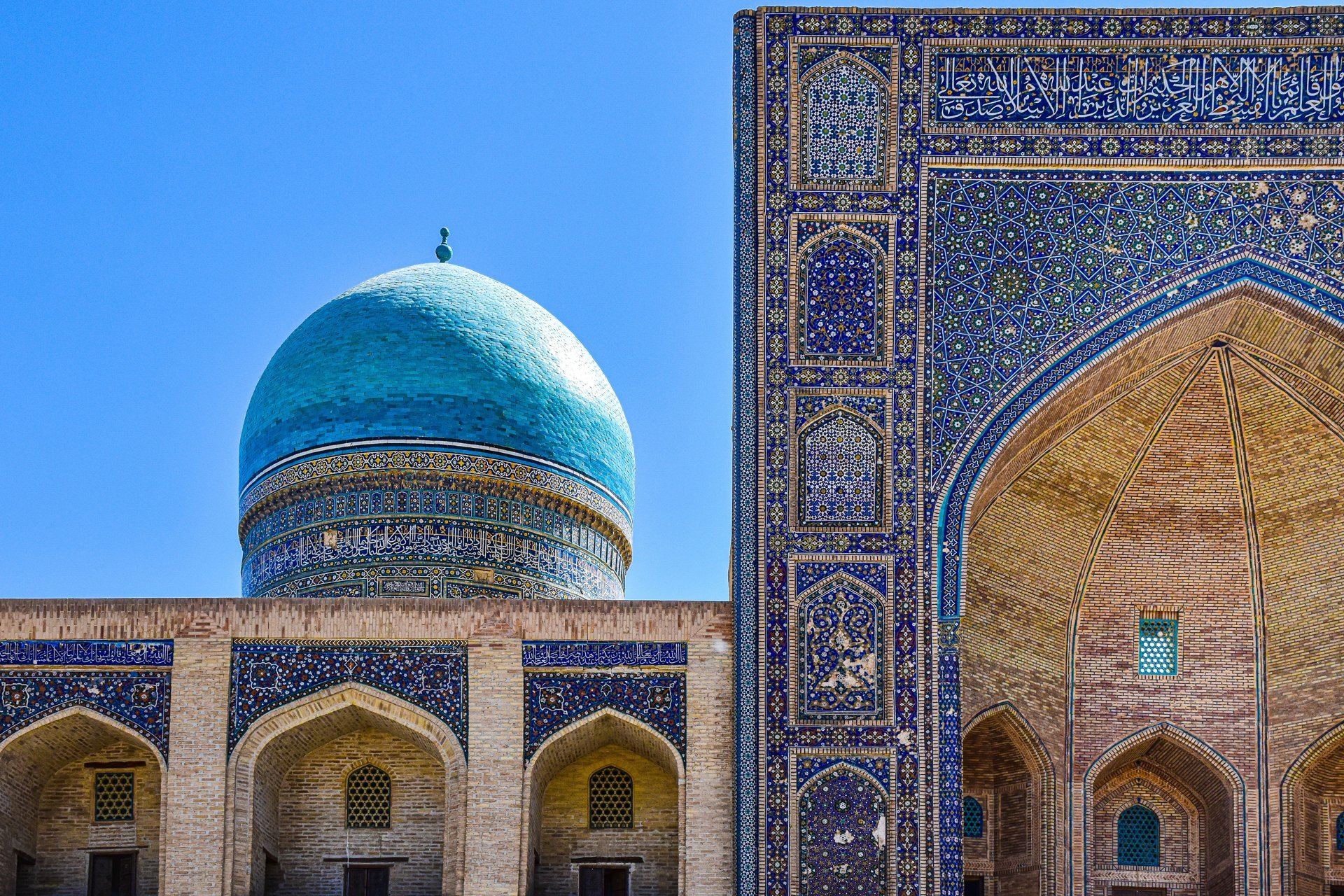
The Mir-i-Arab Madrasa, Bukhara
Sources
World Bank country data; IMF Article IV consultations; OECD reviews of Uzbekistan; Uzbekistan Statistics Agency; World Nuclear Association; United States Geological Survey (USGS).
Data as of 2026, sources: World Bank, IMF, OECD, Uzbekistan Statistics Agency, World Nuclear Association, USGS.
Request an initial diagnostic.
A confidential, structured first conversation on your objectives in Uzbekistan and how we would approach them.