
Report
Uzbekistan's Path to Investment Grade
What the rating agencies need to see, how Uzbek spreads compare with peers, and what a move towards investment grade means for investors.
Nazar Advisory · Tashkent · November 2026
Executive summary
Uzbekistan is rated BB by S&P and Fitch and Ba2 by Moody's, two notches below investment grade at each agency, and Fitch has a positive outlook. The authorities' stated goal is an investment-grade rating by 2030 1 2 3 4. Our view is that a first step to BB+ or Ba1 within the next 12 to 24 months is plausible, while BBB- or Baa3 by 2030 is a stretch target rather than a base case. The constraint is the quality of the balance sheet, not growth.
On fund-reported marks, the median spread on Uzbekistan's dollar bonds has fallen from 313 bps on average in 2023 to 122 bps in July 2026, and from a peak of 524 bps in July 2022 5. Kazakhstan, Armenia, Azerbaijan and Turkey tightened by 44 to 73% between the same two points, against 61% for Uzbekistan, so most of the compression reflects the market and not an Uzbek-specific re-rating.
The relative move is the Uzbek-specific signal. Uzbekistan's spread over Kazakhstan, which is investment grade, averaged about 200 bps in 2024 and was 46 bps in July 2026, and Uzbekistan now trades 18 bps inside Armenia 5. The market already prices Uzbekistan close to the investment-grade end of the region, so the dollar spread reward for crossing the threshold looks modest, in the order of tens of basis points.
The larger improvement is in local currency. The coupon on the three-year soum Eurobond fell from 16.625% in May 2024 to 12.25% in April 2026, and these bonds join JPMorgan's GBI-EM index 6 7 8. For investors and corporates, the main prize of investment grade is therefore a wider and more stable investor base, not a sharply lower dollar spread.
At a glance
BB / BB / Ba2
S&P, Fitch (positive outlook) and Moody's ratings
122 bps
Median USD spread over US Treasuries, July 2026
-61%
Change in spread, 2023 average to July 2026
46 bps
Spread over Kazakhstan (BBB / Baa1), July 2026
c. 210
US-registered fund series holding Uzbek bonds
12.25%
Coupon on the April 2026 three-year soum Eurobond
Sources: ratings 2 3 4; spreads and holders 5; soum Eurobond 7.
1. Where Uzbekistan stands
Table 1: Sovereign ratings
| Agency | Rating | Outlook | Latest action | What the agency cites |
|---|---|---|---|---|
| S&P | BB | Stable | Upgrade from BB-, November 2025 | Macro policy since 2017, energy tariff adjustments, higher reserves; privatization described as slow; rising external and fiscal leverage 2 |
| Fitch | BB | Positive | Outlook to positive, June 2026 (upgraded to BB in June 2025) | Steady structural reforms, privatization and state-enterprise reform, public debt well below the BB median 3 9 10 |
| Moody's | Ba2 | Stable | Upgrade from Ba3, June 2026 | Fiscal discipline, gas subsidies cut from 1.4% to 0.3% of GDP, UzNIF listing; tariffs at full cost recovery targeted for 2027 to 2028 4 |
Saida Mirziyoyeva, who heads the working group on the sovereign rating, set the 2030 investment-grade goal on June 4, 2026 1. The deputy prime minister restated it in August without a date or a target rating level 11. The IMF's baseline is for growth of 6.8% in 2026 and about 6% in 2027, with a fiscal deficit of 2.1% of GDP in 2025 and public debt of 30.9% of GDP in 2024 12. These aggregates are not what keeps the rating in the BB category. The contingent liabilities and external vulnerabilities described in section 4 are.
2. How spreads have moved
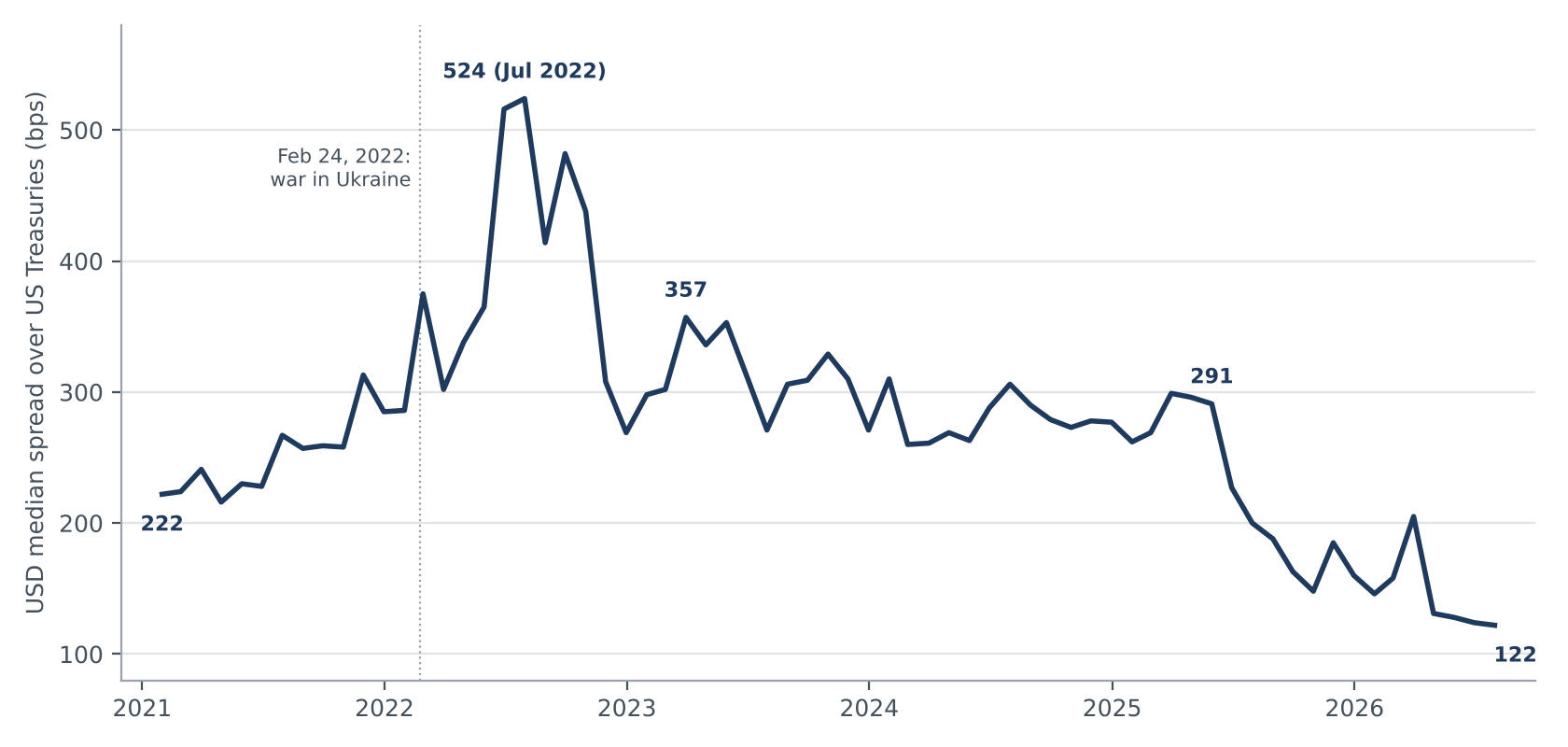
Chart 1: Uzbekistan, USD median spread over US Treasuries, month-end, January 2021 to July 2026 (bps). Source: 5.
Uzbekistan's sovereign risk premium has declined materially since the mid-2022 peak, with the average spread on its USD-denominated Eurobonds falling from around 520 bps then (against about 250 bps on average in 2021) to 313 bps on average in 2023, 280 bps in 2024, 224 bps in 2025 and 145 bps in the first seven months of 2026 5.
This sustained compression reflects a combination of improving macroeconomic fundamentals and stronger investor confidence.
Key contributing factors include robust economic growth, supported by market-oriented reforms and investment; an improving fiscal position, with the budget deficit narrowing to 2.1% of GDP in 2025 and public debt declining to approximately 29% of GDP; and a strengthening external position, supported by higher gold prices, resilient remittance inflows, growing non-gold exports and substantial international reserve buffers 13.
The improvement has also been reinforced by sovereign credit-rating upgrades by Fitch and S&P from BB- to BB in 2025, reflecting the country's improved credit profile 9 2.
While favorable external conditions, particularly high gold prices, have played an important role, the overall trend points to a meaningful reduction in Uzbekistan's perceived sovereign risk and an improved capacity to access international capital markets at more competitive funding costs.
3. Comparison with peers
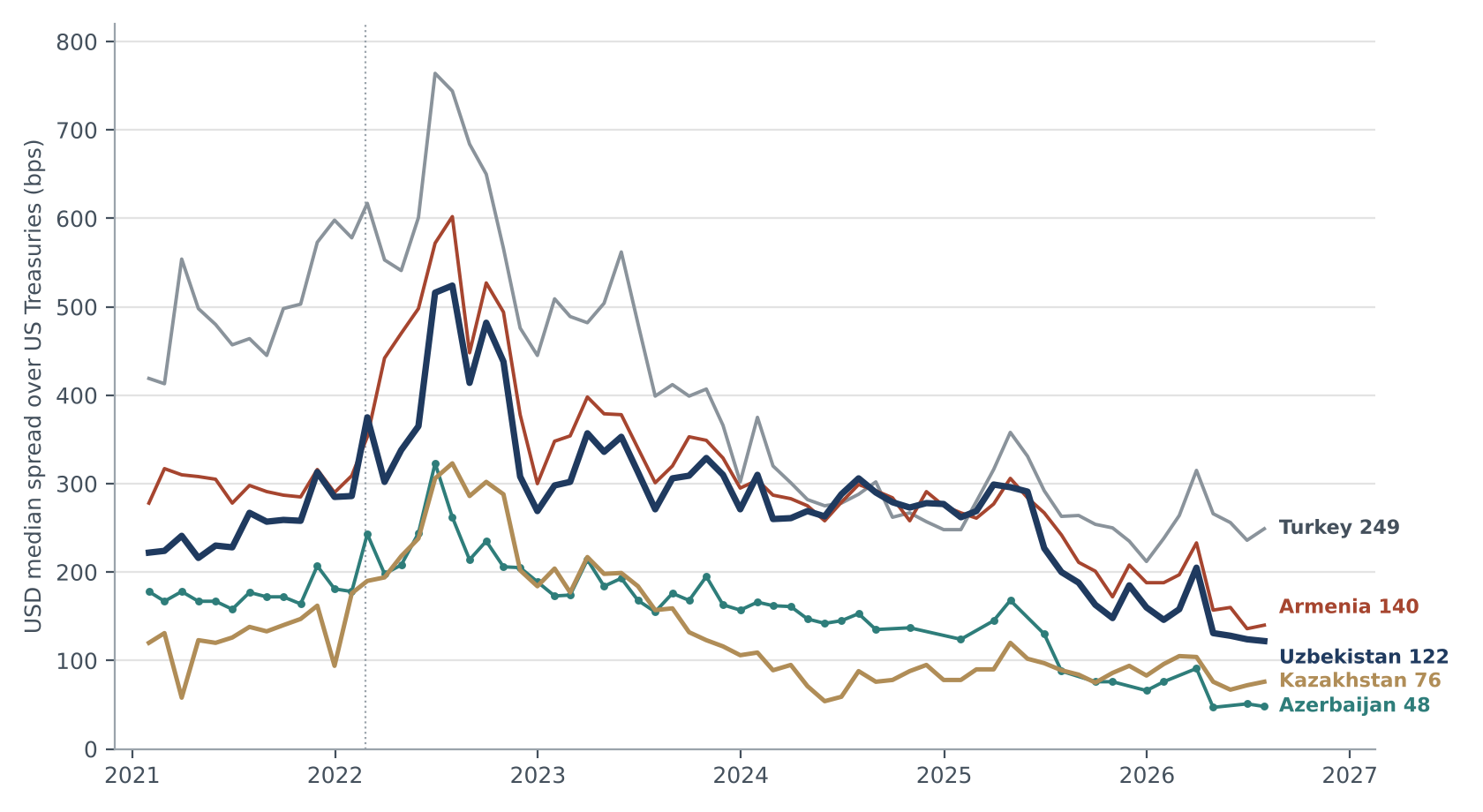
Chart 2: USD median spread over US Treasuries, month-end, fund-reported marks, January 2021 to July 2026 (bps). Azerbaijan: the line joins months with complete filings. Source: 5.
Convergence with Kazakhstan
All five markets peaked in mid-2022 and have compressed since. Between the 2023 average and July 2026, spreads fell by 61% for Uzbekistan, 54% for Kazakhstan, 59% for Armenia, 73% for Azerbaijan and 44% for Turkey (Table 2), so Uzbekistan's improvement is real but shared with the asset class. What is specific is the convergence with Kazakhstan: the gap was 149 bps in 2023, widened to 198 bps in 2024 as Kazakhstan tightened and Uzbekistan did not, and then narrowed to 133 bps in 2025 and 60 bps in January to July 2026 5. The narrowing coincides with the 2025 upgrades.
Table 2: USD median spreads over US Treasuries (bps)
| Issuer | 2023 average | 2022 peak | July 2026 | Change vs 2023 | Ratings |
|---|---|---|---|---|---|
| Azerbaijan | 177 | 323 (Jun 2022) | 48 | -73% | Baa3 Moody's; BB+ S&P, Fitch |
| Kazakhstan | 164 | 323 (Jul 2022) | 76 | -54% | BBB / Baa1 |
| Uzbekistan | 313 | 524 (Jul 2022) | 122 | -61% | BB / Ba2 |
| Armenia | 345 | 602 (Jul 2022) | 140 | -59% | BB- / Ba3, positive |
| Turkey | 443 | 764 (Jun 2022) | 249 | -44% | Ba3 Moody's; BB- Fitch |
Source: 5; Nazar Advisory calculations. Each figure is the median across the USD bonds of sovereign and government-related issuers in the sample. Azerbaijan averages use months with complete filings. Ratings: 14.
The investor base
The investor base is narrower than the spread suggests. About 210 US-registered fund series report Uzbek bonds, with USD 389m in soum bonds, USD 196m in dollar bonds and USD 99m in euro bonds, which tilts the US holder base toward local currency: US funds hold USD 308m of Kazakh dollar bonds against only USD 55m of tenge bonds, and USD 475m of Armenian dram bonds 5. The largest holders are emerging-market debt and local-currency funds, with two Vanguard bond funds also in the top five (Table 3). The data cover US-registered funds only and pre-date the inclusion in the GBI-EM index on September 30, 2026, which could add index-driven demand 8.
Table 3: Largest US fund holders of Uzbek bonds, mid-2026
| Fund | Report date | Bonds | Value (USD m) |
|---|---|---|---|
| Global Macro Absolute Return Advantage Portfolio | Jul 31, 2026 | 4 | 150.9 |
| Vanguard Short-Term Investment-Grade Fund | Jul 31, 2026 | 4 | 114.9 |
| Eaton Vance Emerging Markets Debt Opportunities Fund | Jul 31, 2026 | 4 | 104.1 |
| Vanguard Emerging Markets Bond Fund | Jun 30, 2026 | 4 | 92.5 |
| MFS Emerging Markets Debt Fund | Jul 31, 2026 | 6 | 80.1 |
| Invesco EM Sovereign Debt ETF (PCY), 2.9% of net assets | Jul 31, 2026 | 3 | 40.1 |
Source: 5, from SEC Form N-PORT filings. Positions are in sovereign and related issuers and in several currencies.
Local-currency market
In local currency the story is stronger. The three-year soum Eurobond priced at 16.625% in May 2024, 15.5% in February 2025 and 12.25% in April 2026, about 14 bps below average domestic yields 6 15 7 8. Policy rates have been held at 14% since March 2025 while inflation fell from 9.8% to 7.3% by end-2025, and Moody's raised its local-currency ceiling to Baa3 12 4.
4. What the agencies need to see
Table 4: Constraints on the rating and the evidence
| Constraint | Current evidence | What would help |
|---|---|---|
| Contingent liabilities | About 1,800 state entities; signed PPP contracts at 27% of GDP (authorities estimate direct and contingent liabilities at about 15%); guaranteed debt 5.5% of GDP in 2024 2 | Annual PPP cap (USD 6.5bn for 2025), privatization or liquidation of state entities 2 12 |
| Currency exposure | About 84% of government debt in foreign currency; 37 to 40% of bank loans in dollars 2 | Soum issuance and index inclusion; declining dollarization |
| External balance | Current account deficit 3.9% of GDP in 2025, projected by S&P to reach 5.7% by 2028; gold about 40% of goods exports and over three quarters of reserves; remittances 7.1% of GDP, 78% from Russia 12 2 | Moderating deficits; export and reserve diversification |
| Fiscal position | Deficit 2.1% of GDP in 2025; net government debt rising to about 35% of GDP by 2028; interest at 4.4% of revenue against 0.6% in 2019 12 2 | Tax-to-GDP recovery, tariff cost recovery in 2027 to 2028 12 4 |
| Banking sector | State banks have underperformed; about 15% of loans exempt from borrower-based limits 12 | Competitive privatization of state banks, resolution of non-viable lenders 12 |
Fitch's positive outlook rests on the same reform agenda: about USD 5.1bn of privatizations in 2021 to 2025, state-enterprise reform, the listing of the National Investment Fund and public debt of about 32% of GDP, against a median of about 53% for BB-rated peers. It also flags gold at 41% of merchandise exports, Russia at about 70% of remittance inflows and the trade effects of the Iran conflict 10. S&P links an upgrade to moderating budget and current account deficits, and a downgrade to weaker deficits, weaker growth or contingent liabilities that crystallize 2. This is why we regard the balance sheet, not growth, as the binding constraint.
5. Scenarios and implications for investors
Base case
Our base case, which is a judgment and not a forecast, is a move to BB+ or Ba1 at one or more agencies in 2027 or 2028, supported by the completion of the WTO accession, the tariff reform and the privatization pipeline. Investment grade by 2030 requires contingent liabilities and the external deficit to stabilize, and the outcome could be delayed by a reversal in gold prices, a shock to remittances from Russia, or the Middle East conflict that the IMF flags 12 2 11. Morocco, which lost its investment-grade status in 2021 and regained it with S&P in September 2025, shows that a recovery of this kind takes years and not quarters 16.
What it means for investors
Dollar bonds. With about 45 bps left to Kazakhstan and a holder base concentrated in a few funds, selection and liquidity matter more than timing the upgrade.
Private markets. A higher sovereign ceiling lowers the funding cost of banks and large corporates, which feeds into valuations and refinancing for private debt and private equity transactions.
What we monitor. The PPP commitments cap, the pace of state bank privatization, tariff reform in 2027 and 2028, the current account, and the agencies' review calendars.
For clients assessing Uzbek sovereign or quasi-sovereign exposure, Nazar Advisory can verify current positioning, rating-agency expectations and counterparty appetite directly with the relevant institutions in Tashkent.
For a conversation, contact Guillaume Moinet (guillaume.moinet@nazaradvisory.com) or Zulfiya Zakirova (zulfiya.zakirova@nazaradvisory.com), co-founders of Nazar Advisory.
References
- [1]Government of Uzbekistan (gov.uz), Saida Mirziyoyeva: "Our Strategic Goal Is to Achieve an Investment-Grade Sovereign Credit Rating by 2030", June 4, 2026. https://gov.uz/en/digital/news/view/173034
- [2]Tashkent Times, S&P upgrades Uzbekistan's sovereign rating to BB with stable outlook, November 2025. https://www.tashkenttimes.uz/economy/16482-s-p-upgrades-uzbekistan-s-sovereign-rating-to-bb-with-stable-outlook
- [3]Kun.uz, Fitch affirms Uzbekistan at BB while shifting rating outlook to positive, June 4, 2026. https://kun.uz/en/news/2026/06/03/fitch-affirms-uzbekistan-at-bb-while-shifting-rating-outlook-to-positive-3172b3
- [4]Kun.uz, Moody's upgrades Uzbekistan's credit rating to Ba2 citing structural economic reforms, June 25, 2026. https://kun.uz/en/news/2026/06/25/moodys-upgrades-uzbekistans-credit-rating-to-ba2-citing-structural-economic-reforms-6ea43c
- [5]InsiderStreet, Uzbekistan, Kazakhstan, Azerbaijan, Armenia and Turkey bond pages (median USD spreads over US Treasuries and fund holdings from SEC Form N-PORT filings; data to July 2026; accessed November 2026). https://insiderstreet.ai/bonds/country/uz
- [6]Daryo, Uzbekistan issues $1.5 bn in sovereign bonds in three currencies for the first time in history, May 22, 2024. https://daryo.uz/en/2024/05/22/uzbekistan-issues-15-bn-in-sovereign-bonds-in-three-currencies-first-time-in-history
- [7]Dunyo.info, Uzbekistan raised a billion dollars through placement of Eurobonds, April 13, 2026. https://dunyo.info/en/news/uzbekistan-privlek-milliard-dollarov-cherez-razmeshchenie-evrobondov
- [8]Interfax, Uzbekistan Eurobond placement and GBI-EM inclusion, August 2026. https://interfax.com/newsroom/top-stories/118652/
- [9]Kun.uz, Fitch upgrades Uzbekistan's sovereign credit rating from BB- to BB, June 27, 2025. https://kun.uz/en/news/2025/06/27/fitch-upgrades-uzbekistans-sovereign-credit-rating-from-bb-to-bb
- [10]Tashkent Times, Fitch upgrades Uzbekistan's outlook to positive on back of $5 billion privatization drive, June 2026. https://www.tashkenttimes.uz/economy/17828-fitch-upgrades-uzbekistan-s-outlook-to-positive-on-back-of-5-billion-privatization-drive
- [11]Kun.uz, Uzbekistan aims to secure investment grade status as WTO accession nears completion, August 24, 2026. https://kun.uz/en/news/2026/08/24/uzbekistan-aims-to-secure-investment-grade-status-as-wto-accession-nears-completion
- [12]IMF, Uzbekistan: Staff Concluding Statement of the 2026 Article IV Mission, April 13, 2026. https://www.imf.org/en/news/articles/2026/04/13/mcs041326-uzbekistan
- [13]IMF, Republic of Uzbekistan: Staff Report for the 2026 Article IV Consultation, Debt Sustainability Analysis, May 28, 2026.
- [14]FXEmpire, Sovereign credit ratings pages for Kazakhstan, Armenia, Azerbaijan, Turkey and Uzbekistan (accessed November 2026). https://www.fxempire.com/credit-ratings/kazakhstan
- [15]Interfax, Uzbekistan places Eurobonds totaling $1.5 bln in nat'l currency, dollars, euros, February 2025. https://interfax.com/newsroom/top-stories/110016/
- [16]Morocco World News, Morocco regains investment grade status, September 27, 2025. https://www.moroccoworldnews.com/2025/09/260803/morocco-regains-investment-grade-status-eyes-growth-and-foreign-investment/